Kennametal Top Notch, Laser Cutting, and DMLS vs SLM: A Total Cost Guide
Three Situations, One Question
There isn't one right answer when someone asks me whether they should spend more on tooling, buy an 8000W laser, or switch a part to metal 3D printing. It depends. As of March 2025, I'm still seeing shops make the same mistake: they compare price tags instead of total cost. I've spent six years managing procurement for a 60-person job shop, tracking every invoice in our cost system, and overseeing close to $180,000 a year in tooling and consumables. Every worthwhile answer I've given starts with the same question: what's the total cost, not just the price tag? Let me lay out three common scenarios. The right call for a shop doing mostly CNC turning is different from one doing sheet-metal enclosures, which is different from one chasing complex aerospace prototypes. If you're not sure which one you're in, the checklist at the end will help.
A Cost-First Framework
Before we get into scenarios, here's the framework I use. Every equipment or tooling quote gets five buckets: base price, setup, tooling and consumables, downtime risk, and service response. If a vendor hides something in any of those buckets, it's not a cheaper quote—it's a partial quote. The goal is to compare the full life cycle cost, not just the first-year purchase cost.
Scenario A: You're Running a CNC Turning or Boring Cell
If your work is mostly bar-fed turning, ID grooving, or blind-bore work, the hidden costs are usually in the toolholder. I'll be honest: I don't care about a logo for decoration. But when I see the Kennametal logo on a tool, I know exactly what system I'm dealing with. The shims, clamps, and inserts are specified. That traceability saves setup time.
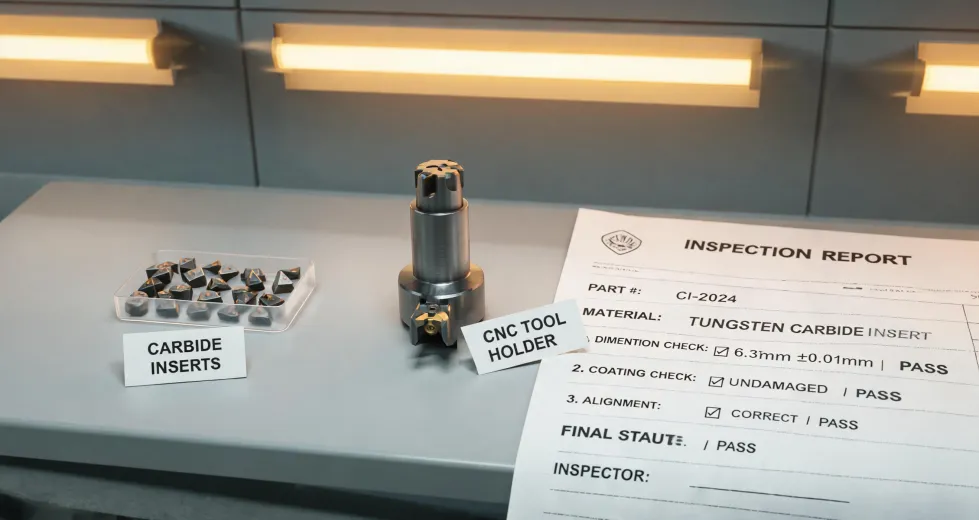
The Kennametal Top Notch boring bar is the tool I keep reordering for internal grooving and threading. It isn't the cheapest bar on the market. It's not the most expensive either. What it does is hold the insert securely enough that I don't have to worry about insert movement when feed rates get aggressive. Less movement means more consistent thread pitch and surface finish. In my cost tracking system, those two factors directly show up as fewer scrapped parts.
Last year I compared eight tooling suppliers for one repeat boring job. The budget look-alike was 30 percent less than the Kennametal option. I almost approved it until I ran the TCO: proprietary inserts, longer delivery, and no application engineer to call when the setup didn't feel right. A single bad batch would have wiped out the savings. Not a guess—I've seen it. A $200 saving can turn into a $1,500 redo when the insert geometry is wrong.
Had 20 minutes to approve a tooling order last month because the operator was waiting. Normally I'd pull up two quotes, but there was no time. I went with the Kennametal part because I had two years of logged performance data on the same material. In hindsight, that's not a bad way to make a time-pressured decision—you're relying on reference points, not price alone.
Before you take my word for it, run a test with your own parts. Put a Kennametal Top Notch boring bar in the turret and run the same material, same speeds, same feeds as the current tool. Track tool life, surface finish, and cycle time. In our shop, that test paid for the holder within two jobs because tool life doubled on one difficult 4140 job.
Scenario B: You're Cutting Flat Sheets and Bending Boxes
If your parts are flat sheet metal with bends, the conversation changes. As of March 2025, I keep seeing shops fixate on a China 8000W laser cutting machine because the price per watt is impossible to ignore. It's hard to argue with a quote that's 40 percent below a European machine. But the machine isn't the system.
Before you approve that laser purchase, calculate the cost of the rest of the system. Installation, electrical work, chiller capacity, training, consumables, and—this is the one people forget—your press brake capacity. Your press brake capacity—tonnage, bed length, stroke, and backgauge travel—is the bottleneck you can't see from a sales brochure. A laser can cut a part in seconds. If your brake can't bend it accurately enough, the part still isn't done. One shop I know bought an 8kW fiber laser, then spent six months sending anything over 2 meters to a local fabricator because their press brake bed was too short. The laser paid for itself slower than planned.
Don't stop at the machine price either. Ask what consumables cost for the first year. A high-power fiber laser uses cutting gas, nozzles, lenses, and maybe a chiller service. Then ask what happens when the laser source needs maintenance. If the nearest technician is six hours away, every breakdown is a multi-day event. That's not a theoretical concern; it's the difference between a profitable month and a break-even month.
Also, ask for service lead times in writing. I still kick myself for not pushing a laser vendor to put their promised response time in the contract. The machine ran fine for three months. Then a resonator issue kept it down for two weeks, and we had to outsource anyway.
Scenario C: You're Producing Complex Metal Parts
The DMLS vs SLM 3D printing question comes up when the drawing has internal channels, lattice structures, or a part that normally needs five setups. Both are laser powder bed fusion processes. Per ISO/ASTM 52900, the umbrella term is laser powder bed fusion, or L-PBF. But the trade names still matter in quotations and specifications.
DMLS—direct metal laser sintering—uses a laser to sinter metal powder, usually below its full melting temperature. SLM—selective laser melting—uses a laser to fully melt the powder in selected areas. In practice, SLM parts can be fully dense, while DMLS parts are often near-fully dense but may have more porosity depending on material and parameters. That difference drives mechanical properties, fatigue life, and post-processing.
When I compared DMLS and SLM options side by side for a customer's bracket, the surprise wasn't the price gap. It was how much the material cert and post-processing cost affected the final number. One vendor's SLM quote was higher, but they included stress relief and hot isostatic pressing. The DMLS quote looked cheap until those steps were added as line items.
Don't choose a process by name. Ask for density, tensile strength, and elongation data at the same layer thickness. Then ask how the vendor handles support removal and surface finish. Those answers tell you more than the acronym.
Also, don't assume additive is only for prototypes. If a part has deep bores or internal cooling channels that can't be drilled, additive can eliminate a multi-operation nightmare. But if you can machine it from bar stock in 12 minutes, additive is probably the wrong answer. I've turned down plenty of additive RFQs because the part didn't need the capability.
How to Know Which Scenario You're In
Here's a practical checklist I use before recommending anything:
- What's the primary part shape? If it's round, bored, threaded, or grooved, start with Scenario A. Your toolholder is likely the highest-leverage place to spend money.
- Is it flat and bent? Then you're in Scenario B. Check your press brake capacity before you size a laser cutter, and add a full year of service cost to any machine quote.
- Is the geometry only possible in additive? Then go to Scenario C. Compare DMLS vs SLM vendors on material data, not marketing language.
- What does your TCO spreadsheet say? If you don't have one, build it. Include setup, tooling, scrap, rework, downtime, and service. Price per unit is a starting point, not an answer.
Not every purchase is a test of patience. But the ones that burn you are usually the ones you rushed. I've made that mistake. The fix isn't to become an expert in every process. It's to ask the same cost questions before every decision: What's the total cost? What can break? And what happens if it does?