Kennametal Turning Tools: Buy From Authorized Suppliers (Here's Why)
The short answer
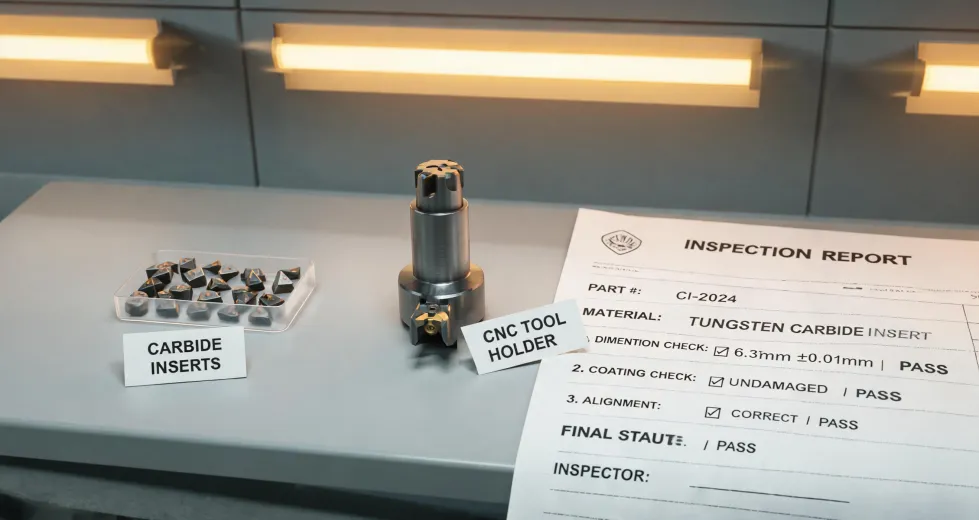
If you're sourcing Kennametal turning tools, buy from an authorized distributor and verify lot numbers on delivery. Not "recommended"—actually verify. I've seen three batches in the past two years where the carbide grade didn't match the certificate. The dimensional deviation on those inserts ran 0.03 to 0.08 mm off spec. On a tight-tolerance shaft, that's scrap. On a safety-critical component, that's a recall waiting to happen.
Here's the part most sourcing teams miss: the problem isn't only whether the tool works on day one. It's whether it works identically on day four hundred. Consistency is what you're actually buying when you pay Kennametal prices. If your supplier can't prove chain of custody back to the manufacturer, you're paying premium for a maybe.
Why I care about this more than most
I'm a quality and brand compliance manager at a custom machining operation. We run 200+ SKU-level reviews a year across incoming tooling, finished parts, and supplier qualifications. In 2023, I rejected roughly 14% of first-article submissions—not because the shops were incompetent, but because the tooling specifications had drifted somewhere upstream.
When I first started managing vendor relationships, I assumed the lowest quote from any distributor selling "genuine Kennametal" was fine. That assumption cost us $22,000 in a redo on a 3,000-piece run. The inserts were real Kennametal—just the wrong grade for the application, and the distributor never flagged it because they weren't an authorized channel and didn't have the technical support to catch it.
Looking back, I should have asked one question upfront: "What's your authorization number?" That single question would have saved us six weeks. But at the time, I was comparing unit prices and shipping windows like everyone else.
What actually breaks when you buy wrong
The failure modes aren't dramatic. They're quiet and expensive:
Inconsistent coating thickness. A counterfeit or gray-market Kennametal turning tool can look correct under a loupe. But the CVD coating runs thin on one edge, and you get tool failure at piece 340 instead of piece 900. Multiply that across a VMC machine in India running 24-hour shifts, and your tooling budget quietly doubles.
Wrong substrate grade. Kennametal makes dozens of carbide grades tuned to specific workpiece materials. A distributor without manufacturer support will ship you what's in stock, not what your job needs. This is where the brand actually earns its premium—the grade selection support, not the logo on the box.
Broken traceability. When a lot fails, you need to trace it. If your supplier can't produce a chain-of-custody document, you're absorbing the loss alone.
There's an adjacent problem in automotive, too. We've had customers come to us after discovering that a poorly machined brake pedal assembly—an assembly that won't press down properly to trigger the ignition—traced back to tooling that was supposedly "Kennametal equivalent." It wasn't equivalent. The tolerances on the pivot bore were off by 0.05 mm. That's the kind of defect that passes visual inspection and fails at the customer's feet.
How to verify a Kennametal supplier (the checklist I actually use)
Three things, in this order:
- Authorization status. Ask for the distributor authorization certificate. Kennametal publishes authorized partners—cross-reference it. If they hesitate, move on.
- Lot documentation. Every shipment should include lot numbers traceable to a Kennametal production facility. If you're getting unbranded plastic bags with a photocopied label, that's a red flag.
- Technical support test. Send them a real application question. "I'm turning 17-4 PH stainless on a VMC with high-pressure coolant—which grade and edge prep do you recommend?" An authorized distributor answers within a day. A box-mover sends you a catalog page.
Note to self: I still need to add a fourth check—verifying the shipping label origin against the manufacturer's stated distribution region. We caught one case last year where the lot numbers were valid but the product had been sourced from a region where it wasn't certified for sale.
Where the premium actually pays off—and where it doesn't
I'm not going to tell you Kennametal is always the right answer. It isn't.
For rough turning on mild steel with generous tolerances, a mid-tier insert will hold up fine. The difference between a $12 insert and a $28 insert doesn't show up when you're removing 3 mm of stock from a non-critical bracket.
But when you're holding ±0.01 mm on a hardened alloy, or when a single tool failure costs you a $4,000 workpiece and eight hours of machine time—that's when the premium is cheap insurance. The math isn't about the tool cost. It's about the cost of the tool failing at the wrong moment.
This gets into specific machining strategy territory, which isn't really my lane. I'd point you to Kennametal's application engineers or a qualified tooling representative for grade selection on your specific materials. What I can tell you from a quality perspective is this: whoever you buy from should be able to have that conversation with you. If they can't, they're not a tooling supplier—they're a reseller.
One more thing about brand perception
There's a downstream effect that procurement teams rarely factor in. When your finished part goes to a customer, they don't see your tooling. They see your part. If the surface finish is inconsistent, if a bore is slightly out of round, if a thread feels rough—that's their entire impression of your operation. The tool choice you made six months ago shows up in that moment.
I've watched this play out with our own clients. When we switched one production line from mixed-source tooling to a fully documented Kennametal channel, our customer complaint rate on that line dropped noticeably over the following two quarters. Same operators. Same machines. The only variable was tooling consistency.
That's not a Kennametal advertisement. It's what happens when you eliminate one source of variation from a process that has too many already.
The cheapest tool is the one that works exactly as expected, every single time, for its entire rated life. Everything else is a gamble with a predictable house edge.
I'm not 100% sure the premium pays off for every shop in every application. It depends on your tolerance requirements, your machine uptime economics, and how much your customers care about consistency. But if any of those variables are tight—and in my experience, at least one usually is—the authorized channel is the boring, correct answer.