Kennametal Boring Bars: What I Verify Before They Touch the Spindle
The Short Answer
Verify the Kennametal logo and the full part number before you spend a single dollar on Kennametal boring bars. A correct part number doesn't guarantee a good bore, but a missing or blurry logo guarantees you're starting with risk. In our Q1 2025 tooling audit, I rejected 8% of first deliveries because the spec didn't match the actual bar—wrong shank, wrong insert seat, or no clear branding. That 8% didn't include the bars that passed inspection but failed on the machine.
The bottom line: 5 minutes of verification beats 5 days of correction. That sounds like a slogan, but I have the rework tickets to back it up.
Why I'm the One Writing This
I'm a quality/compliance manager at a custom machining shop. I review every tooling line item before it reaches the floor—roughly 200 orders a year. When I implemented our verification protocol in 2022, first-article failures dropped by about 35%. I don't get paid by Kennametal. I get paid to keep bad parts from leaving our building.
Look, I'm not saying other boring bar brands are bad. I'm saying the cost of guessing is too high when the material, the shift schedule, and the customer are all expensive.
Start With the Kennametal Logo, Not Just the Price
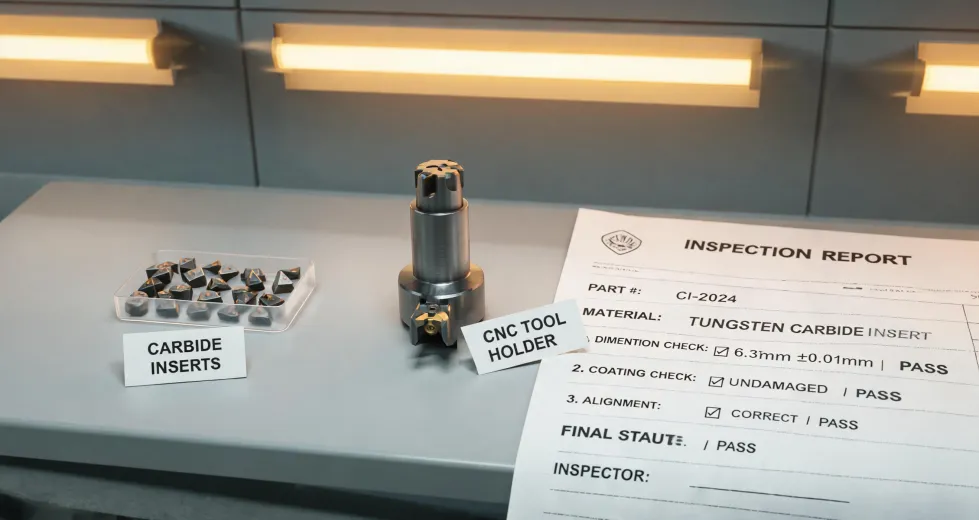
Real Kennametal bars are laser-marked near the shank with a clear Kennametal logo. The full part number should be right there with it. I use Kennametal's online catalog as the reference; if the marking doesn't match the catalog photo and drawing, I don't trust it.
I still kick myself for a gray-market deal I almost approved in 2023. The upside was $800 in savings. The risk was a scrapped aerospace bracket and a very unhappy customer. I kept asking myself: is $800 worth potentially losing that account? The logo on the sample bar was the answer. It didn't look right. We dodged that one.
A blurry logo, a missing lot code, or a price that's 30% below everyone else? Red flag. Don't let the supplier tell you the logo is “just cosmetic.”
What I Actually Check on Kennametal Boring Bars
Here's the thing: a boring bar is not a universal tool. You can have the right insert grade, the right coating, and still fail because the bar geometry or holder interface is wrong. So I built a checklist after a bad batch in 2024. It's saved us an estimated $8,000 in potential rework since then.
- Bar diameter and shank style compared to the holder taper. CAT40 is not CAT40 from every brand; verify the pull stud and gauge line.
- Insert seat size and screw torque. A loose insert will chatter before you get to the bottom of the bore.
- Reach and length-to-diameter ratio. A 5xD bar gives you reach, but it also amplifies vibration.
- Coolant-through ports. The part number says it, but I measure the coolant hole diameter anyway.
- Kennametal logo and lot code, because counterfeit or gray-market bars don't always fail loudly.
I once had a batch of 50 bars where the insert seat was ground 0.010 inch off. Normal tolerance is 0.001. The vendor said it was “within industry standard.” It wasn't. We rejected the batch, and they redid it at their cost. Now every PO includes insert seat tolerance.
I went back and forth between a 3xD and a 5xD Kennametal boring bar for two weeks. The 3xD offered rigidity. The 5xD offered reach. On paper, the 5xD won because the drawing called for a 4.8-inch bore depth. Ultimately I chose the 3xD and added a second setup. The tolerance was ±0.0005, and I didn't want to gamble on chatter.
That decision wasn't about brand loyalty. It was about the cost of a redo.
Beware of One-Pass Thinking
The phrase “one pass to finish” is the most expensive sentence in machining. It's also where a search for something completely unrelated made me feel better about being stubborn.
If you search for “co2 laser skin resurfacing charlotte nc”, you'll get a list of clinics. But if you ask “how many co2 laser treatments are needed for scars”, the honest answer is: it depends. Scar depth, skin type, healing time. No reputable provider promises “one treatment and gone.” Boring is the same. The number of roughing and finishing passes depends on stock, material, and machine stiffness. Anyone who guarantees one pass to final size without seeing the setup is guessing.
The same lesson shows up in an “elegoo saturn 4 ultra 16k resin 3d printer review”. That printer can produce absurdly fine detail—16K resolution is impressive. But the printer doesn't guarantee a perfect print. You still need supports, exposure calibration, and post-processing. The machine is capable; the setup is what makes it succeed. A Kennametal boring bar works the same way.
So when someone asks me how many CO2 laser treatments are needed for scars, I can't answer as a doctor. But I can tell you the pattern: if anyone gives you a fixed number without variables, they're selling something. Same in boring.
Where This Doesn't Apply
Not every job needs this level of verification. If you're cutting a one-off repair with ±0.01 tolerance and the part isn't critical, a visual check and a worn bar will probably get you through. I've used cheaper bars on prototype work. I'm not the “only OEM tooling” guy.
But if the run is long, the material is expensive, or the tolerance is tighter than ±0.001, I don't skip the inspection. The protocol isn't about Kennametal being sacred. It's about knowing, before the spindle turns, that the bar you're using is exactly the bar you specified.
There's something satisfying about a bore that comes in at 2.0002 on the first attempt. It starts with checking the Kennametal logo, the part number, and the holder taper before the bar ever gets chucked up. That satisfaction doesn't happen by accident.