How to Evaluate a Kennametal Tooling Supplier: A 5-Step Checklist for Engineers and Buyers
-
Who This Checklist Is For
-
Step 1: Verify Technical Capability, Not Just a Catalog Match
-
Step 2: Demand Proof of Specification Compliance — Not Just a Certificate of Conformance
-
Step 3: Check for Application-Specific Solutions, Not Just Hardware
-
Step 4: Compare Total Cost of Ownership — Not Just Unit Price
-
Step 5: Confirm Their Approach to Quality Assurance and Support Infrastructure
-
Final Thoughts: Build a Repeatable Process
Who This Checklist Is For
If you're sourcing Kennametal tooling — turning inserts, boring bars, holders — for your shop, this walkthrough is for you. It's for the engineer or buyer who's been handed a stack of quotes and needs a repeatable way to separate decent suppliers from ones that'll cost you in rework. I've been on both sides: specifying tooling and receiving it. This checklist is what I wish I'd had from day one.
We'll cover five steps, from verifying technical specs to calculating true cost per part. By the end, you'll have a process you can use for every Kennametal order.
Step 1: Verify Technical Capability, Not Just a Catalog Match
The first and most common mistake: assuming a supplier who stocks Kennametal products can actually deliver to your specific requirements. Having the brand in inventory is not the same as understanding it.
I assumed this once. We needed a specific K-series grade for a stainless steel turning job. The supplier confirmed they carried Kennametal. When the inserts arrived, they were a generic substitute — same geometry, different grade. The chip control was terrible. We scrapped 40 parts before catching it. That $200 'savings' over a specialist turned into a $1,800 problem when we accounted for material loss and machine downtime.
What to ask:
- Do they stock the specific Kennametal grade you need? Not just 'Kennametal inserts,' but the exact ISO classification and coating variant.
- Can they provide a recent Kennametal turning insert grade chart or reference documentation proving their stock list is current? Kennametal updates these regularly.
- For boring bars: ask about their stock of different shank sizes and coolant-through capabilities. A standard bar might not fit your application if you're running high-pressure coolant on a stainless job.
Direct them to the Kennametal website or your own printout of the grade chart. Make them confirm, not assume.
Step 2: Demand Proof of Specification Compliance — Not Just a Certificate of Conformance
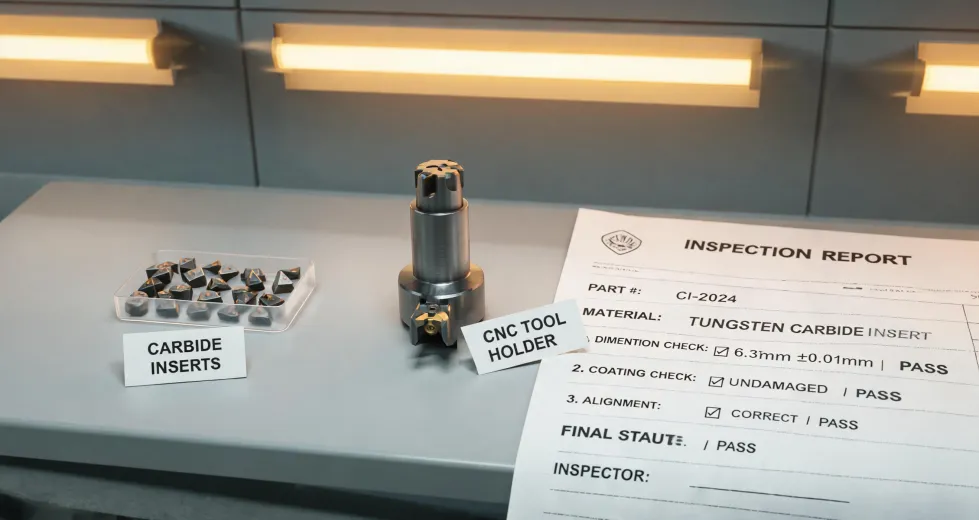
Here's where my 'Quality/Brand compliance manager' hat comes on. A piece of paper saying 'this meets spec' is worth the paper it's printed on unless someone actually checked. We didn't have a formal verification process for incoming tooling. Cost us when a batch of tool holders had a runout of 0.005 inches instead of the specified 0.002. The impact? Chatter on a finish turning operation. The parts looked fine to the naked eye but failed the profilometer test. That was a 50-unit redo, all at our labor cost.
Your checklist:
- Ask for dimensional inspection data. For a boring bar, that means shank diameter, length, and insert pocket location. For a tool holder, it's clamping force and runout.
- Specify your incoming inspection protocol. Tell the supplier: 'We will check runout on the first three units. We expect all to be within 0.002 inches TIR.' If they balk, that's a red flag.
- For carbide inserts: Ask about the actual substrate and coating thickness. Kennametal's grading system is precise. If they can't tell you the specific grade code for an insert marked 'KC5010,' move on.
I've seen suppliers claim 'within industry standard' when their product was visibly off. Get the data first.
Step 3: Check for Application-Specific Solutions, Not Just Hardware
This step separates suppliers from partners. Anyone can sell you a Kennametal boring bar. A good supplier asks about your material, your machine's rigidity, and your coolant setup.
For a recent stainless steel turning project (304 SS, CNC lathe with a 12-station turret), we needed a better solution for internal grooving. A potential supplier offered a standard Kennametal grooving tool. It would have worked. But a specialist supplier recommended a modified bar with a specific chipbreaker geometry optimized for stainless. The performance difference was night and day — 35% faster cycle time and consistent chip breaking where we previously had stringers.
How to test this:
- Describe your exact application: 'We're turning 316L stainless steel, OD, at 600 SFM. We need a Kennametal insert for finishing with a 0.015 IPR feed. What grade and geometry do you suggest?'
- See if they ask about your coolant pressure, depth of cut, and required surface finish. If they don't, they're order-takers, not application engineers.
- Ask about alternatives to standard items. For example: 'What's the best Kennametal boring bar for a 1.5-inch diameter hole in 4140 steel with a 4:1 length-to-diameter ratio?' A shallow answer means they're just reading a catalog.
A supplier who dives into the specifics of your chip load and insert geometry is more likely to save you from a costly trial-and-error process.
Step 4: Compare Total Cost of Ownership — Not Just Unit Price
This is where I take a clear stand: the cheapest quote has cost me more in 60% of cases.
I tracked this across 15 major tooling orders over one year. The 'lowest price' supplier was the source of 70% of our tooling-related quality issues. The math is straightforward: that $50 cheaper boring bar might save you $50 now, but if it wears out in half the time or causes a single scrapped part, you've lost money. On a 500-part run, one scrapped part at $80 material cost alone erodes any per-unit savings.
Calculate this:
- Cost per part (including tooling wear). Chances are, a premium Kennametal grade insert will give you 500 parts vs. 350 from a generic alternative. Even at a 20% higher insert price, your per-part cost drops.
- Setup and changeover time. If a cheaper tool requires more frequent indexing, that's downtime. At $100/hour machine rate, every extra index costs you.
- Rework and scrap rates. This is the killer. A tool that 'works most of the time' creates uncertainty. Every part has a small chance of being a reject. Over a year, that adds up.
I have mixed feelings about the 'buy cheap' mentality. On one hand, budgets are real. On the other, I've seen a $1,000 tooling cost rise to $3,500 in hidden expenses. A specialist supplier who can document their quality and provide application support is often the cheaper option in the long run.
Step 5: Confirm Their Approach to Quality Assurance and Support Infrastructure
You're not just buying a product; you're buying a system. If the tool fails at 8 PM on a Saturday, what happens?
I learned this the hard way. We had a rush order for aerospace components. Three hours into the run, a tool holder broke. The OEM supplier was closed. Our primary Kennametal distributor had an emergency contact. They shipped a replacement by 7 AM the next day. We finished the order on time.
What to verify:
- Do they have an after-hours or emergency support channel?
- What is their process for handling a quality complaint? Do they offer a replacement or credit, or do you have to fight for it?
- Can they provide technical documentation — grade charts, application guides, or even CAD files — for the products they sell?
A supplier with robust support infrastructure is a safety net. The one who disappears after the invoice is paid is a liability.
Final Thoughts: Build a Repeatable Process
These five steps aren't a one-time exercise. Make them part of your procurement SOP. The time you spend filtering suppliers upfront is nothing compared to the cost of a bad batch of tools halting production.
Remember: brand matters, but verification matters more. Kennametal tooling is high-quality when specified and handled correctly. The difference between a good outcome and a disaster is often in how your supplier manages that specification. Don't just buy the brand. Buy a supplier who can prove they understand it.
Pricing for tooling varies widely based on volume, specific grade, and market conditions. Verify all quotes and capabilities directly with your supplier before ordering.