CNC Machining vs. FDM 3D Printing in China: What a Kennametal Shop Learned From 200+ Rush Orders
A new operator in our shop asked me last week: "do you have to press on the brake to start a car?" I almost laughed. On most modern cars, yes — you physically cannot start the engine until the brake pedal is engaged. The car makes you complete one small, safe check before something potentially dangerous happens. I told him that's exactly how machining should work. Then I got to thinking about how often we skip that kind of safe check in part production.
I'm a production coordinator at a custom machining company. I've handled 200+ rush orders in five years, including same-day turnarounds for aerospace and medical device clients. Last quarter alone, we processed 47 rush orders with a 95% on-time record. On every rush order, the first decision is the same: should this part be machined, or should it be printed? In our shop, we spec Kennametal tooling for most jobs — solid carbide boring bars, end mills, and inserts from the Kennametal catalogue — so I know the CNC side well. But I've also approved, rejected, and shipped FDM parts made in China. Both routes have saved a project for me. Both have also cost me one.
This article compares those two routes directly. I'll compare them on four dimensions that matter when the deadline is real: speed, accuracy, material and cost, and failure risk. If you're an engineer or buyer weighing a CNC machining service quote against an FDM print, this is the framework I wish someone had handed me years ago.
Speed: The Fastest Option Depends on the Quantity
If you count raw time from "file sent" to "part in hand," FDM usually takes the first round. Send an STL to an FDM 3D printing service in China and printing can start within the hour. A simple part reaches the US or Europe in three to five days by express shipping. CNC machining needs a quote, toolpath programming, material sourcing, and setup before the first chip is cut. That's a slower first step, and the difference is real.
But here's where my initial assumption was wrong. When I first started coordinating part production, I thought the shortest lead time was the best lead time. I treated a three-day delivery promise as a fixed number. Three reprints later, I learned otherwise: a part that fails after arrival isn't a three-day part. It's a three-week part.
The second thing I underrated was batch speed. A 3D printer produces the hundredth part exactly as fast as the first. A CNC machine, once set up and with the first article verified, drops the remaining units in minutes each. Based on our internal data from 200+ rush orders, FDM wins the lead-time race for quantities under five. CNC machining wins for quantities over twenty — consistently, even when setup is counted. We once had a 40-unit order fully delivered in the time an FDM service quoted for a second batch of samples. The surprising conclusion: for anything beyond prototype quantities, machining is the faster service.
Accuracy and Finish: Kennametal Solid Carbide Boring Bars Make It Uneven
Here the comparison gets lopsided. FDM builds parts from melted plastic, laid down in 0.1 to 0.3 mm layers. Those layers are visible as lines, but the bigger problem is structural: a part loaded perpendicular to the layers can fail at half the strength of the same part loaded along them. Dimensional accuracy, without post-processing, is around ±0.2 mm on a well-tuned machine.
CNC machining holds a completely different class of tolerance. A machining center equipped with Kennametal solid carbide boring bars will hold internal bores within IT7 to IT8 grade tolerances — roughly 0.01 to 0.03 mm total tolerance for diameters between 10 and 30 mm. That isn't a marketing claim; it's published data in the Kennametal catalogue, and it matches what we measure on our test cuts. When a drawing calls out a true position on an internal bore, there is no real decision to make. That part gets machined, with rigid tooling and a documented setup.
Surface finish follows the same pattern. Machined surfaces hold Ra 0.4 to 1.6 micrometers straight off the machine. To reach a similar finish on FDM, you sand or chemically smooth it — and those operations each remove 0.1 to 0.3 mm of material, erasing the tolerance you were chasing. Put another way: you can have a smooth printed part or an accurate printed part, but usually not both.
A real example from March 2024: a client needed 12 locating sleeves for a test fixture, 36 hours before a scheduled production trial. A vendor quoted $90 for an FDM 3D printing service in China. The risk was obvious: the sleeves would sit in a steel housing under clamp load, and that's exactly where printed plastic creeps. We quoted a machined version at $210 — produced with Kennametal solid carbide boring bars — and delivered in 28 hours. The client went with it. That $120 difference was the cheapest insurance I've ever bought.
Material and Cost: The Break-Even Is Around 30 Pieces
FDM is limited to thermoplastics: PLA, PETG, ABS, nylon, and filled blends. Those are fine for prototypes, jigs, and parts that carry no heat and no real load. CNC machining covers aluminum, steel, stainless, brass, titanium, and most engineering plastics — materials that FDM cannot touch at all.
On price, the data changes with the quantity. Based on publicly listed rates I checked in January 2025, a simple PLA bracket (roughly 50 × 50 × 30 mm) from a China-based FDM service costs about $12 to $25 including basic finishing. The same bracket in 6061 aluminum, quoted online through a CNC machining service, runs about $35 to $80 as a single piece. So for one part, FDM looks cheaper. Then order 50. Machining costs drop as setup is amortized; FDM prices stay flat. The aluminum part becomes cheaper per unit somewhere between 30 and 50 pieces — before you even factor in strength.
Shipping shifts the math less than you'd think. Express delivery from China to the US runs roughly $15 to $25 for either option, as of early 2025. A machined part weighs more, but not enough to change the conclusion. The bigger hidden cost is iteration. Printed quotes hide the reprints, warping, and dimensional drift that come out of your timeline, not the vendor's invoice. Machined quotes hide setup and tooling fees, but you pay them once. A Kennametal boring bar has been in our tool cabinet for four years, if I remember correctly — it paid for itself by its third job.
Failure Risk: The Comparison Nobody Puts in a Spreadsheet
This is the dimension that gets ignored until something breaks. If a 3D-printed part fails in service, you reprint it and wait another three to five days. There is no repair. If a machined part fails, you can troubleshoot it — check tool geometry, adjust feeds and speeds, re-measure the blank. The failure is traceable, and the correction is finite.
We learned that in 2023. A client needed a jig for a qualification test, and we ordered a rush FDM print from China with a four-day turnaround. It arrived on day six, warped 1.2 mm across a locating face. The client missed the test slot they'd booked six weeks earlier. The total damage — rush fees, failed test, rebooking, and an emergency machined replacement — was over $3,000. The print itself cost $70. Our company policy now requires a 48-hour buffer on every promised delivery date, because of what that $70 print cost us.
"Do you have to press on the brake to start a car? Yes — because a single check prevents a whole category of accidents. Five minutes of verification beats five days of correction."
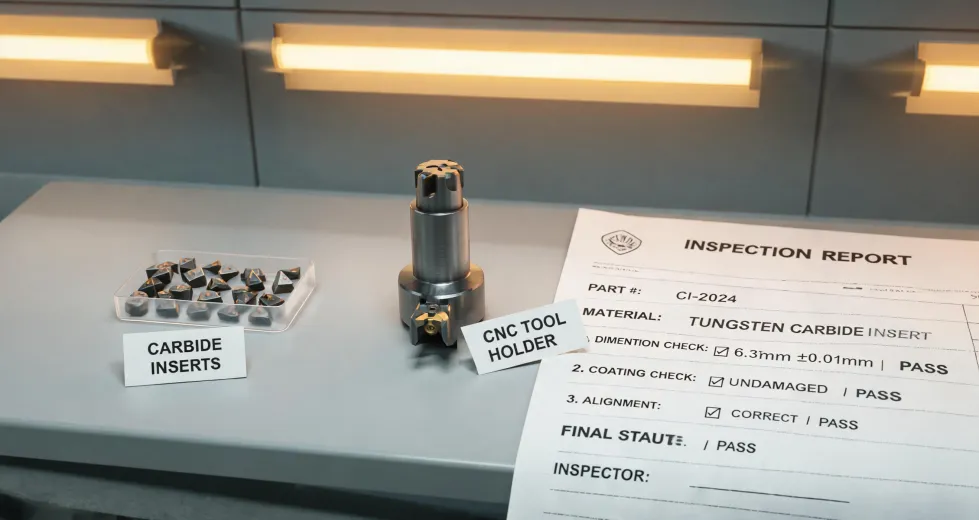
That discipline now lives in a 12-point checklist I created after my third avoidable mistake. It has saved us an estimated $8,000 in potential rework. It includes confirming the drawing revision, verifying material grade, looking up the cutting tool and its recommended parameters in the Kennametal catalogue, checking toolholder runout, and measuring the first article before running the rest of the batch. None of those checks takes more than five minutes. Each one has prevented at least one expensive failure.
Which Should You Choose?
If you need a form-fit mockup, a visual prototype, or a part that carries no load and no heat, an FDM 3D printing service in China is a legitimate choice. It's fast, cheap, and its failure mode is cheap to absorb.
If you need functional parts — anything with bores, threads, or mating surfaces — CNC machining is the route I'll put my name on. Get a CNC machining service quote that names the tooling. For internal diameters, specify Kennametal solid carbide boring bars and ask the shop to confirm cutting parameters against the Kennametal catalogue before the first pass. That single sentence in your RFQ prevents a whole category of quality arguments later.
If you need 50 or more identical parts, the lead-time and cost math both point to machining. If you need exactly one part in 24 hours, don't assume 3D printing is faster. A local machine shop with expedite capability will often beat a printer, because one failed print resets your entire timeline. A machined part, by contrast, is checked and measured before it ships.
And before you commit to either, ask the brake question: what one check am I tempted to skip that could cause the crash? On a modern car, the interlock makes that check automatic. In production, you are the interlock. Choose the process that lets you verify, not the one that asks you to hope.