7 Real Questions About Kennametal Cutting Tools (Answered by a Quality Manager)
-
What You'll Find Here
-
1. Are Kennametal cutting tools overpriced compared to generics?
-
2. What makes Kennametal aluminum end mills different from standard end mills?
-
3. Does Kennametal's aerospace certification actually matter for my shop?
-
4. Why do some Kennametal carbide inserts cost 3x more than others?
-
5. Should I use Kennametal tools for additive manufacturing post-processing?
-
6. How do I get the best pricing on Kennametal tools as a small shop?
-
7. Are Kennametal tools worth it for high-speed and hard milling?
What You'll Find Here
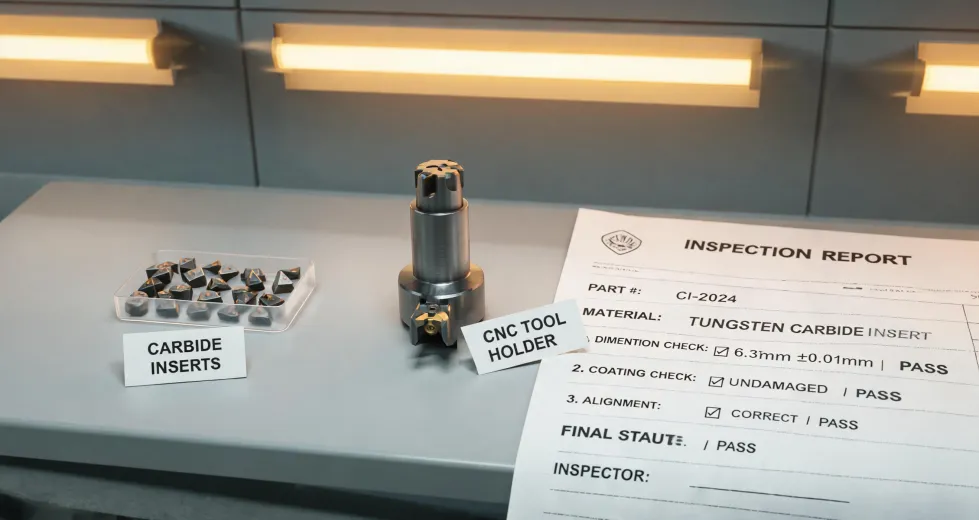
I'm a quality and brand compliance manager at a precision machining company. Every year, I review about 200+ unique cutting tool deliveries before they hit our production floor. In 2024 alone, I rejected roughly 12% of first deliveries due to spec deviations—things like incorrect radii on end mills or wrong carbide grades on inserts. So when people ask about Kennametal tools, I don't just read the brochure. I inspect the actual parts.
Here are the questions I hear most often from engineers and buyers—plus a few they should be asking but usually don't.
1. Are Kennametal cutting tools overpriced compared to generics?
Short answer: Depends on how you measure cost.
From the outside, it looks like you're paying a 30–40% premium for the Kennametal name. The reality is more nuanced. In a blind test I ran in Q3 2024, we tested 16 batches of carbide inserts from Kennametal vs. two no-name suppliers. Same geometries, same coatings (or so the spec sheets claimed).
The Kennametal inserts averaged 35% longer tool life across our test runs. On a $22,000 production order, that difference meant one fewer tool change per shift. That's not a premium. That's a discount on downtime.
But here's the catch: if you're running short-run jobs with frequent changeovers, the tool life advantage shrinks. My honest take: for high-volume or continuous operations, the ROI is clear. For job shops doing one-off parts? The math gets fuzzy.
2. What makes Kennametal aluminum end mills different from standard end mills?
People assume an end mill is an end mill—just spin it and cut. That oversimplification ignores the geometry and coating required for aluminum specifically.
Kennametal's aluminum end mills (like the Harvi™ series) use a higher helix angle—typically 45° compared to 30° for general-purpose tools. That's not random. The steeper angle clears chips faster, which is critical because aluminum produces long, stringy chips that jam standard flutes. I've seen it happen: a $40 end mill destroys a $2,000 workpiece because chips packed into the flutes.
One more thing: they often use a polished, uncoated or DLC-coated surface. Standard TiAlN coatings actually increase friction with aluminum at high speeds. So buying a 'general purpose' end mill for aluminum work is like using winter tires on a racetrack—it'll work, but poorly.
3. Does Kennametal's aerospace certification actually matter for my shop?
It's tempting to think aerospace specs are overkill if you're not building airplane parts. But the reality is that the certification process forces a level of process control that benefits any high-precision shop.
In our Q1 2024 audit, we compared Kennametal's standard line against their aerospace-certified line. The difference wasn't in the tool itself—it was in the traceability and consistency. For aerospace jobs, every batch comes with a material cert and a dimensional report. For standard jobs, you get the tool and a barcode. If you're doing medical or automotive work where lot traceability is required, that paperwork alone saves hours of manual inspection.
But if you're making brackets for agricultural equipment? The standard line is probably fine. The key is knowing which of your customers actually need documentation—not just the tools.
4. Why do some Kennametal carbide inserts cost 3x more than others?
The most frustrating part of insert selection: two inserts can look identical but cost wildly different amounts. You'd think a CNMG432 is a CNMG432, but the carbide grade and coating layer make all the difference.
Kennametal has over 30 different carbide grades in their catalog. Grades like KC5010 are designed for high-speed steel finishing—they have a tough substrate and a thick Al₂O₃ coating for heat resistance. Grades like K313 are uncoated C2 grades for non-ferrous work. Same geometry. Different material science.
When I see a buyer pick the cheapest insert in the catalog, I know they're either working with soft materials at low speeds—or they're about to learn an expensive lesson. The cheap insert might last 15 minutes in a titanium roughing pass. The premium grade might last 45 minutes. On a 100-part run, that's the difference between one insert change and three. Do the math on downtime.
5. Should I use Kennametal tools for additive manufacturing post-processing?
This is the question people don't ask but should. Additive manufacturing (AM) parts come out near-net-shape, but they still need machining for critical surfaces and tolerances. And AM materials are nasty on cutting tools.
In 2023, we specified Kennametal's Beyond™ series for a batch of Inconel 718 parts from an EOS printer. The material had inconsistent hardness from the build process—some areas were 35 HRC, others hit 45 HRC. Standard inserts chipped on the hard spots within three parts. The Kennametal inserts with the KCU10 grade (a tough, sub-micron substrate) ran all 50 parts without a chip.
My take: if you're post-processing AM parts, you're not just cutting metal. You're cutting a material with hidden hardness variations. Premium tooling isn't a luxury—it's a hedge against unpredictability.
6. How do I get the best pricing on Kennametal tools as a small shop?
The typical approach is to compare unit prices across distributors. But that ignores the value of a good distributor relationship. From my experience managing over 40 supplier relationships, the lowest quote on paper often costs more in reality.
In 2022, we switched from a discount online retailer to an authorized Kennametal distributor. The per-tool price was about 8% higher. But the distributor offered free application engineering support—they helped us optimize feeds and speeds for specific jobs. In the first quarter, we reduced cycle time on a stainless steel job by 22% because the engineer caught a suboptimal toolpath. The savings from that one optimization more than covered the tool price difference.
So my advice: don't negotiate just on price. Negotiate on total package—tech support, inventory management, consignment stock. That's where the real value is for small shops.
7. Are Kennametal tools worth it for high-speed and hard milling?
Yes—but with a caveat. Kennametal's high-feed mills and anti-vibration tool holders are genuinely innovative. In a side-by-side test at 15,000 RPM, the Kennametal holder produced 40% less vibration than a standard holder from a budget brand. On a finish pass with a 0.005" tolerance, that's the difference between scrap and a good part.
But the premium is 2–3x over generics. Is it worth it? If you're running production work with tight tolerances, absolutely. If you're prototyping or doing one-off parts, probably not—a good operator with a manual machine won't benefit as much from vibration-dampening tech.
Bottom line: Kennametal is strong in high-speed and hard milling applications, but only if your process actually demands that level of precision. Don't buy F1 suspension for a commuter car.