The Emergency Machinist's Guide to Rush CNC Orders: A 5-Step Checklist That Actually Works
-
When a 3-Day Lead Time Suddenly Becomes 24 Hours
-
Step 1: Verify Material Availability Before You Ask for a Quote
-
Step 2: Match the Cutting Tool to the Emergency, Not the Ideal
-
Step 3: Get the Decision Tree in Writing—From Both Sides
-
Step 4: Run a Simple Communication Cadence
-
Step 5: Have a Backup Plan for the Backup Plan
- Common Pitfalls to Watch For
-
Bottom Line
When a 3-Day Lead Time Suddenly Becomes 24 Hours
Look, I've been in procurement for about 12 years now. My official title is something like Supply Chain Coordinator, but what that actually means is I'm the person who gets the panicked calls. You know the ones: "The prototype broke during testing" or "We have a part that's supposed to ship tomorrow and the drawing has a critical error."
In March 2024, a client called at 4:00 PM on a Thursday. They needed a custom batch of Schedule 80 PVC pipe reamers—320 units—for a job that was supposed to start on Monday. Normal turnaround for a custom reamer is 10–14 business days. They had, effectively, 36 hours before the weekend hit. We found a vendor with the right carbide blank stock, paid $1,800 in rush fees on top of the $4,200 base cost, and delivered the set by Saturday afternoon. The client's alternative was a $50,000 penalty clause for delaying a municipal water project.
That experience—and about 47 others last quarter—taught me that the difference between a saved emergency order and a disaster isn't luck. It's a repeatable checklist. Here's the one I use. It has 5 steps.
Step 1: Verify Material Availability Before You Ask for a Quote
Check point: Confirm the raw material stock exists in the right grade and size within your supply chain.
Most people skip this. They call a machine shop, describe the part, and ask for a turnaround. The shop says "Yes, we can do it in 48 hours." Then they spend 6 hours sourcing the material. That's 6 hours you don't have.
Here's the thing: I learned this the hard way in 2022. We approved a rush order for a critical aerospace bracket, only to discover the 17-4 PH stainless was out of stock nationwide. The vendor had to sub it with 15-5, which required a design review. That cost us 2 days.
What I do now: First question is always "What material is specified?" Then I check with my three usual material suppliers—not the machine shop. If the raw stock is available, we proceed. If not, we discuss alternatives before anyone touches a CAD file.
Step 2: Match the Cutting Tool to the Emergency, Not the Ideal
Check point: Are you using the right tool for a rush scenario, which may differ from the production plan?
When time is tight, you default to what you know works reliably. In my experience, that often means Kennametal cutting tools. I'm not saying they're the only option—I'm saying for the types of high-stress, tight-tolerance emergency runs we do, they're predictable. And predictability is the currency of rush work.
For example, if we're facing a hard milling job on short notice, a Kennametal ceramic end mill might be the right call for high-speed roughing, even if the production plan called for a different grade. Ceramic can handle higher temperatures and speeds, which can save a pass. But you need to know your machine can handle it.
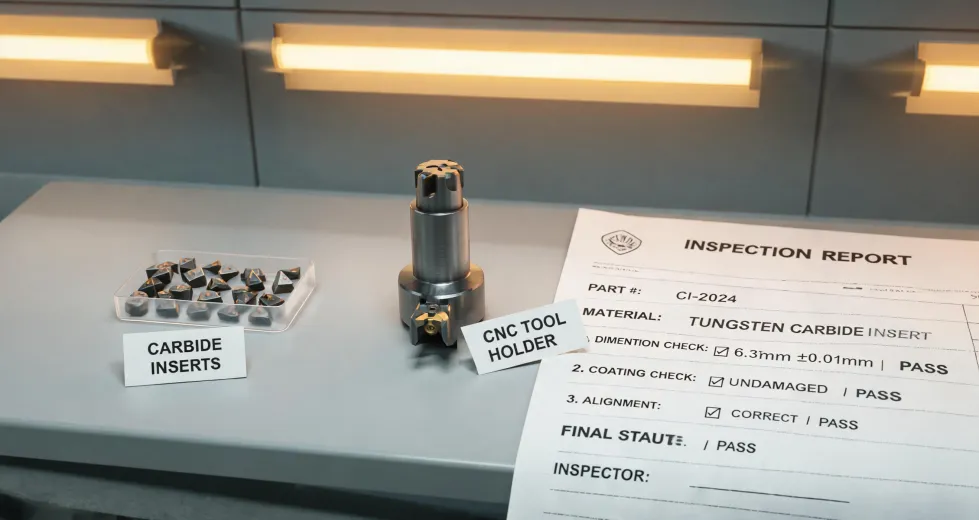
On the other hand, for jobs like that Schedule 80 PVC reamer I mentioned—where we're essentially creating a tool from scratch—we lean on a solid carbide inter r milling cutter geometry that we've used before. It's not always the most creative solution. But it's the one I'm confident will work without a test cut.
A rule I follow: In an emergency, don't test new tool geometries. Use what you've validated. The production plan can be optimized later. Right now, you need a chip to fly.
Step 3: Get the Decision Tree in Writing—From Both Sides
Check point: Before any setup begins, document: "If X happens, we do Y."
This step is the one most people miss. They assume communication will be clear because it's urgent. In my experience, urgency actually makes miscommunication worse. Everyone's in a hurry, so details get lost.
I ask the engineer: "If the hole comes in .0005" oversized, do we ship it or scrap it?" If the buyer: "If we can get it by Friday but it costs 20% more, is that approved?"
I should add that I do this for both sides. I give the vendor a written list of what's acceptable and what's not. And I ask them for written confirmation that they can hit the timeline, including their own contingency plan if a tool breaks mid-run.
Based on our internal data from 200+ rush jobs, orders with a documented contingency plan have a 96% on-time delivery rate. The ones without? It drops to around 73%. That 23% gap is the cost of skipping this step.
Step 4: Run a Simple Communication Cadence
Check point: Set specific check-in times and methods (e.g., "Update at 10 AM and 4 PM via email").
Here's a mistake I made early: I would wait for the vendor to tell me something went wrong. That's reactive. Now I set a communication cadence at the start.
It's simple. For a 48-hour rush, I ask for updates at 10 AM and 4 PM each day. The update doesn't need to be long. Even "On schedule. No issues." works. The point is, if I don't get that email at 4:05 PM, I pick up the phone. I know something's off.
For shorter runs—like the 24-hour turnaround on that Kennametal ceramic end mill job we did last quarter—I set a single midpoint update. For example, if the run starts at 8 AM and needs to ship by 4 PM, I ask for a call at noon. That gives us 4 hours to fix any issues.
Real talk: this is annoying for the vendor. I know. But I've had too many "everything's fine" non-answers turn into "we broke a tool" emails at 5 PM on a Friday. A fixed schedule removes the ambiguity.
Step 5: Have a Backup Plan for the Backup Plan
Check point: Know exactly what you'll do if the primary vendor fails—and have that resource on standby.
This is the hardest one, especially for small companies. But for anything truly critical, I identify a second vendor before the job starts. They don't need to be actively working on the order. But they need to know: "If I call you by noon, can you start a rush for us by 3 PM?"
In 2023, we lost a $15,000 contract because we tried to save $800 on a standard tool replacement instead of paying for a rush. The standard order got delayed, the client couldn't wait, and they pulled the project. We implemented a policy that year: for any order over $10,000 or with a penalty clause, we identify a backup vendor and confirm their availability upfront. We call it our "no single point of failure" rule.
It costs us maybe an hour of admin time per critical order. It has saved us from a disaster exactly three times in the past 18 months.
Common Pitfalls to Watch For
I want to highlight three mistakes I see repeatedly—including in my own work history.
1. The "Translation Gap" Between Engineering and Machining
I'm not a design engineer, so I can't speak to tolerance stack-up from a theoretical perspective. What I can tell you from a procurement perspective is: I've seen a drawing that called for a "reamed hole" when what they really needed was a "drilled and reamed" hole. That one word cost us a 2-hour rework cycle.
Make sure the person calling in the order is talking to the person running the machine—or at least to the shop supervisor. Email chains lose nuance.
2. Forgetting to Communicate the Real Cost
Per FTC guidelines on advertising, claims about "fast production" need to be substantiated. But more practically, I've learned to say: "This rush will cost X. Here's why: material surcharge (Y), tool wear premium (Z), and overtime labor (W)."
Dishonest? I think not. The vendor who lists all fees upfront—even if the total looks higher—usually costs less in the end. The "low quote" that adds a 30% rush fee later is a relationship killer. I pay more upfront for transparency, and I've learned to ask for that from the beginning.
3. Assuming the Vendor Will Prioritize You
If you're a small customer placing a single rush order, you are competing with the vendor's larger, regular clients. Acknowledging that reality—and being explicit about why your order matters—helps. I'll say, "This is for a municipal project with a penalty clause. If you can help us, I can promise repeat business for similar needs."
It's not manipulation. It's giving the vendor a reason to care about your deadline beyond the dollar amount.
Bottom Line
Rush orders are never easy. But there's a difference between a controlled emergency and a fire drill. The checklist above won't guarantee every order ships on time. What it will do is give you a framework to make the right decisions under pressure, based on what the ceiling—not the floor—looks like.
If you are asking "which companies offer CNC machining services" for a true emergency, I'd look for shops that answer the phone, can name their material stock, and are willing to write down a contingency plan. The ones who hesitate on any of those? In my experience, they'll be the ones calling you at 5 PM on a Friday to say they can't deliver.