Cutting Tool Receiving Checklist: Kennametal End Mills, Laser Cutting, and 3D Printed Fixtures
-
1. Verify the part number against an official source
-
2. Inspect packaging and storage conditions before unpacking
-
3. Check edge geometry and coating on a sample
-
4. Run a test cut before a critical production run
-
5. When laser cutting is involved, define edge quality in the purchase order
-
6. If the deadline is critical, pay for certainty—then inspect it anyway
-
7. Calibrate 3D printers and question recycled filament claims
-
Common Mistakes to Avoid
I'm the quality compliance manager at a contract machining company. I review between 60 and 80 incoming tooling deliveries per quarter, and in 2024 I rejected about 7% of first deliveries because of wrong part numbers, damaged coatings, or edge damage that would have caused scrap on the floor. This checklist is what I actually use before accepting tooling and custom components. It's written for engineers and buyers who need to stop problems before they reach the spindle.
If that sounds fussy, it's because it is. Fussy at receiving saves arguments later.
1. Verify the part number against an official source
Before anything else, compare the part number on the box with your purchase order. Then confirm that part number is still current. We buy Kennametal end mills on a regular cycle, and I've caught distributors listing old product codes as direct replacement when the geometry or coating was different. A phrase like should work the same does not belong in a quality system.
For Kennametal products, I check the Kennametal official website and compare the catalog number, grade, coating, flute length, and shank size. If a tool has been superseded, ask for the manufacturer's supersession notice. Last year this step caught two mismatched lots before they went to the tool crib.
I should add: record the lot number on the receiving report. Same part number from different lots can have different coating batches. You may need to trace it later.
2. Inspect packaging and storage conditions before unpacking
Tooling can be damaged in transit. Check for crushed corners, wet cardboard, and broken seals. In Q1 2024 we received an order of Kennametal end mills in boxes that looked fine from the outside. The inner sleeves had split, and flutes were knocking against each other. Several edges were nicked.
The supplier argued that the tools were still within diameter tolerance. What I mean is, a nicked cutting edge can still measure within tolerance, but it will not cut consistently. We rejected the batch and asked them to review the packaging layout. The replacement order arrived clean and cut normally.
3. Check edge geometry and coating on a sample
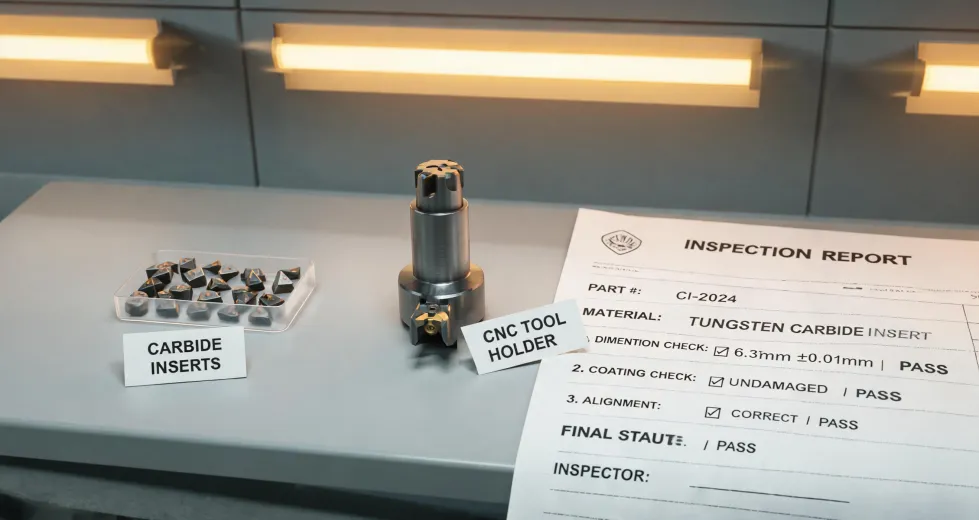
You do not need a full metrology lab for a quick receiving inspection. Use a 20x loupe and a micrometer. Measure shank diameter, flute diameter, and look for chipped cutting edges. Check the coating for patchy or burned-looking areas. Some color variation between coating batches is normal, but variation across one edge is not normal.
If a carbide end mill has a tiny chip near the corner radius, put it aside. The overall diameter can still be within spec, but the edge is already compromised. I have made the mistake of thinking a small nick would disappear after the first pass. It does not. It transfers its inconsistency to the surface finish.
4. Run a test cut before a critical production run
Visual inspection cannot catch runout, edge prep differences, or a coating that is not as advertised. When an order is large or the job is critical, run one tool from the batch in a clean holder and the exact workpiece material used in production. Use the feed rate and speed from the catalog, then measure surface finish and tool wear. Compare the result with your process baseline.
I have never fully understood why some suppliers resist this. Asking for actual measured data is not a personal attack. It is verification. At least, that has been my experience in medium-run production. A 10-minute test cut beats a 100-piece scrape every time.
5. When laser cutting is involved, define edge quality in the purchase order
Laser cutting is an important process step, but it is not a black box. If your supplier is a sheet metal shop with a fiber laser cutting machine Singapore operators use every day, ask how they control dross, burrs, and edge taper. It surprises me how often edge condition is missing from the PO.
I once approved small laser-cut holes that looked clean from the top. The underside had dross, and we did not notice until a tapping operation broke. That defective batch cost us a $22,000 redo and delayed the launch by two weeks. Now I write it down: laser-cut edges free from dross and sharp burrs; break sharp edges 0.1 to 0.3 millimeters. If the edge matters downstream, include it in the first article inspection.
Honestly, I'm not sure why more suppliers do not include this by default. My best guess is that they quote material and cut time, not what happens after the part leaves the bed.
6. If the deadline is critical, pay for certainty—then inspect it anyway
Rush fees are polarizing. I used to treat them as invoice padding. In March 2024, we paid $400 extra for a guaranteed delivery slot on a special toolholder. The alternative was a $15,000 penalty for stopping a customer line. The extra payment did not just buy speed. It bought a firm answer and a reserved window. The vendor had to plan around us instead of saying we will try.
Let me rephrase that: uncertain cheap is more expensive than certain expensive. But rush delivery does not replace this checklist. Expediting gets the parts to your dock faster. It does not guarantee the part number, edge quality, or test cut result.
7. Calibrate 3D printers and question recycled filament claims
3D printed fixtures are common in our prototype area, and failures can waste a day. Most people who ask what causes spaghetti in 3D printing expect a slicer setting answer. In my experience, it is usually a first layer adhesion problem. The first layer peels off the bed or catches on the nozzle, and the printer drags thin plastic strands over the part. Wet filament, a dirty build plate, or a z-offset that changed during transport create the same mess. Add a preflight check and you avoid most waste.
The 3D printer filament recycler market has grown quickly, but recycled filament is not automatically equivalent to virgin material. Scrap must be sorted, dried, and extruded within a stable diameter range. If the company says recyclable, ask for the recycling location and the blend they accept. Per the FTC Green Guides (ftc.gov), an unqualified recyclable claim needs to be accurate for at least 60 percent of consumers or community recycling programs. That is not a marketing detail. It is a material claim you can verify.
Common Mistakes to Avoid
Here are a few reminders from recent audits.
- Checking dimensions but not edge condition. A part can be within tolerance and still fail in service.
- Signing the carrier delivery note before opening anything. Once you sign, damage claims are harder.
- Choosing Kennametal end mills or any cutting tool on price alone. Compare geometry, coating, substrate, and support service.
- Assuming laser cut parts are ready for tapping without inspecting small holes for dross.
- Buying a used laser cutting machine Singapore dealers advertise as low hours without checking the lens, nozzle, and rails.