I'd Rather Pay the Rush Fee Than Trust a "Probably Fine" Tool Holder
-
Argument 1: Spec compliance is where budget tool holders quietly fail
-
Argument 2: Do the math — downtime laughs at the price difference
-
The unusual angle: 3D printer resin taught me about prevention
-
But wait — isn't a tool holder just a tool holder?
-
Final position: certainty is worth exactly what it costs
Let me say this upfront: I've rejected more "acceptable" tool holders than most buyers will touch in a decade. As the guy who signs off on every tooling order before it reaches the production floor, I've seen what the price gap actually buys you. And I've paid Kennametal rush shipping fees three times in the past two years — I'd do it again tomorrow without hesitating.
Here's my position: when your Haas VMC machine — a VF-2, say — is sitting idle because a tool holder isn't right, the money you "saved" on a cheaper alternative wasn't actually saved. It was deferred, with interest. The premium for certainty is an insurance policy that actually pays out.
Argument 1: Spec compliance is where budget tool holders quietly fail
In our shop, we run Kennametal lathe tool holders, end mill holders, and the occasional hydraulic chuck on the VF-2 and two older machining centers. We made Kennametal our default spec about four years ago. The reason wasn't one dramatic failure — it was the accumulation of small, annoying inconsistencies from cheaper sources.
In Q1 2024, we received a batch of 25 CAT40 tool holders from a budget supplier. The drawbar thread depth on six of them was visibly off. Normal spec is about 0.50 inches of engagement, give or take a couple of thousandths. These were short by 0.030 to 0.040 inches. The vendor claimed it was "within industry standard." We rejected the batch, and they eventually redid it at their cost. But the damage was done — that machine was booked solid for the week.
Here's what that cost us, roughly: 40 hours of lost spindle time at about $95 per hour all-in, or around $3,800. The holder we ordered cost maybe $140. The money "saved" by using the budget supplier evaporated inside of two days.
That's the thing people don't factor into the price comparison. The holder's purchase price isn't the real cost. The real cost is what happens when the holder doesn't work and the spindle is waiting. I don't know a single shop with a spare VF-2 sitting around for these situations.
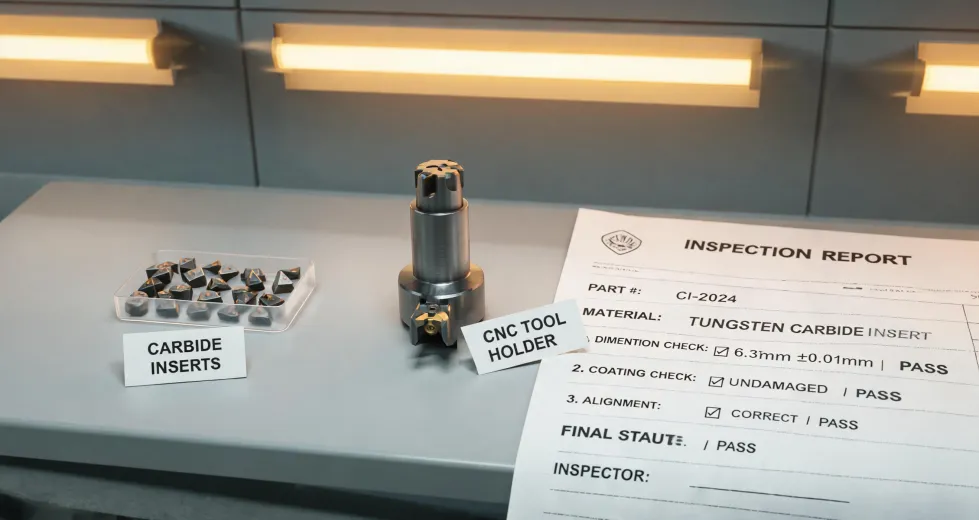
When I spec Kennametal, I can pull the product drawing from the Kennametal website and verify critical dimensions before the order ships. That doesn't sound glamorous, but it's the difference between receiving parts that match the drawing and receiving parts that "roughly match, probably." For a quality inspector, "probably" isn't a specification.
Argument 2: Do the math — downtime laughs at the price difference
The most common pushback I hear is, "Kennametal tool holders cost more than the no-name equivalents." True. But the only number that matters when you're on deadline is what an idle machine costs.
A Haas VMC machine VF-2, tooled up with an operator, runs somewhere between $75 and $120 per hour depending on your burden rate and how you allocate overhead. As of 2025, in a typical U.S. job shop, I'd estimate on the higher end. If that machine sits for two days waiting on a tool holder, that's $1,200 to $1,900 in machine time alone. No late penalties included. No rescheduling chaos. No expedite fees to catch up downstream.
Now, the actual holder price gap? A Kennametal CAT40 holder runs $110 to $250 depending on style and configuration. An off-brand equivalent might be $60 to $150. The difference is often $30 to $80. You are risking $1,200+ of machine time to save what is, in the grand scheme, a single hour's worth of overhead.
I remember one specific case in March 2024. We paid $400 extra for expedited shipping on a Kennametal boring bar holder because a $15,000 order had a hard ship date that week. The alternative was telling the customer we'd be late — which would have cost us the job, the relationship, and probably next year's repeat work. The $400 wasn't even a discussion. It was the price of keeping a promise.
There's a hidden layer here too, especially if you import tooling. The vertical machining center HS code, and more specifically the correct HS code for tool holders, matters more than you think. Tool holders for machine tools fall under HS 8466.10 — I want to say 8466.10.00 in most harmonized systems, but don't quote me on the extension, it varies by country. If your supplier's paperwork is sloppy, that "cheap" holder sits in customs for days while your machine waits. I've seen it happen. Not on our shop floor, but close enough that we now verify documentation before ordering internationally.
We didn't have a formal approval chain for rush orders. That cost us when an unauthorized rush fee showed up on an invoice in 2022 — finance was not thrilled. And the third time we ordered the wrong quantity of a specific holder, I finally created a verification checklist. Should have done that after the first time.
The unusual angle: 3D printer resin taught me about prevention
Couple of years ago, I got UV resin on a good work shirt while a colleague set up a small 3D printer in our office. If you've ever Googled how to get 3D printer resin out of clothes, you know what I'm talking about. Isopropyl alcohol soaks. Scrubbing. Warm vinegar, freeze it, acetone — the internet has a dozen theories. Some work, some make it worse, and you still might end up with a permanent stain in the shape of "I should have worn an apron."
The real lesson isn't about stain removal. It's that fixing the problem costs many times more than preventing it. Gloves cost 10 cents. An apron costs $12. Wearing both takes ten seconds. And you still won't do it until you've ruined one shirt and spent an evening scrubbing it.
Honestly, I'm not sure why more people don't learn that the easy way. My best guess is that prevention is boring, and nobody wants to hear "wear the gloves."
Tooling is exactly the same. The cheap holder works until it doesn't, and then you're spending time you don't have fixing a problem that should have been engineered out. The brand premium is just the apron.
But wait — isn't a tool holder just a tool holder?
I hear that one all the time. "CAT40 is CAT40. The holder just kinda holds the tool." "Kennametal makes great inserts, but a holder is a cylinder with a taper." "You're paying for the name."
I get it. On paper, it's a simple part. But taper accuracy, concentricity, heat treatment, pull stud geometry, and mating surface finish determine whether the holder runs true at 10,000 RPM, whether the tool survives the job, and whether your part passes inspection. The difference between "within spec" and "sort of near spec" becomes obvious on the first scrapped part.
To be fair: not every premium brand deserves its premium, and there are respectable mid-tier options. But when I need a published spec, documented materials, and a phone number that gets answered, I don't gamble. Let me rephrase: it's not a brand loyalty thing. It's a total-cost calculation, and the unit price is only one line in the ledger.
Final position: certainty is worth exactly what it costs
I'm not saying you should buy Kennametal tooling for everything, always, no questions asked. For jobs with long lead times and flexible customers, budget tooling will absolutely do the job. I've used my share of it.
But when the machine is down, the deadline is real, or the customer is already watching the calendar, the premium for certainty is the easiest cost to justify in the entire job. The difference between a $140 holder and a $70 holder is one hour of machine time. The difference between "it shipped" and "it arrived, on spec, ready to run" can be an entire customer relationship.
The cheapest option is only cheap if everything goes right. And "probably fine" is the most expensive estimate I know.