I Rejected 200 Cheap Carbide Inserts. The $1,500 Lesson Changed How I Buy Cutting Tools
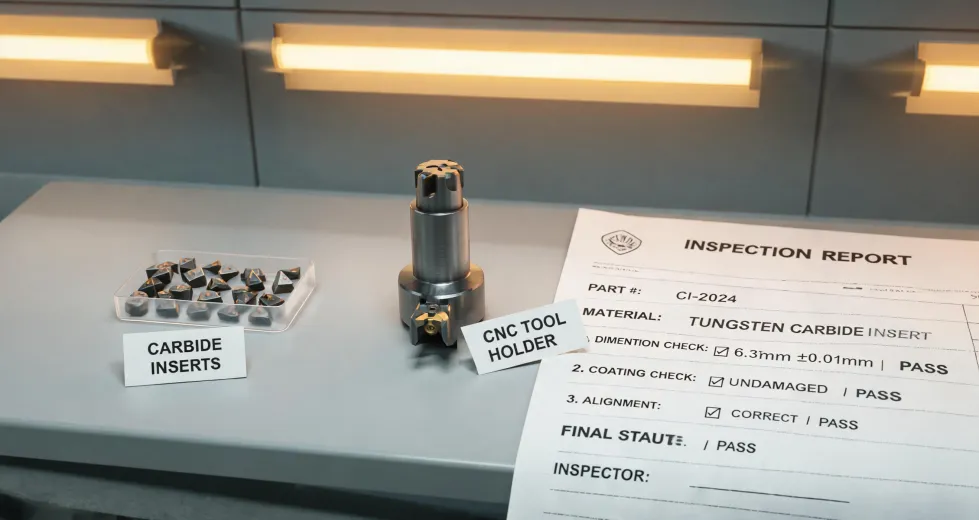
It started on a Monday. My purchasing manager walked into the inspection office with a quote from a new supplier. 'Same inserts, 40% cheaper,' she said. I remember glancing at the email and feeling a knot in my stomach. I didn't say no. That was my mistake.
The setup
For context, I run quality for a small medical job shop that does a lot of CNC machining for prosthetics. Not huge production lines, more like 50,000 units a year across hips, knees, and custom titanium parts. Every batch of raw material has a heat number. Every tool has a traceable setup sheet. I've reviewed roughly 200 tooling SKUs annually for the last four years, and I've rejected my share of first deliveries. In 2023, I almost approved a batch that could have cost us a customer.
Here's the thing. I don't have hard data on industry-wide defect rates for cutting tools. What I can say from our shop is that we reject maybe 5-6% of first deliveries—maybe 6, maybe 4, I'd have to check the annual report. This batch was one of them.
The batch that looked right
The vendor's quote listed the same ISO geometry as the Kennametal carbide inserts we normally used. Same grade, same coating, same nose radius. The price difference was significant: on an order of 200 inserts, the nominal savings was about $600. We were in the middle of a budget review. I told purchasing to place the order.
When the box arrived, I unboxed it in the inspection room. Packaging was clean. The inserts had the correct markings. The coating looked even. I put one under the toolmaker's microscope and measured the nose radius. It was supposed to be 0.4 mm. I got 0.38. Then I measured another: 0.42. Then a third: 0.35.
The spread was 0.07 mm, about seventy microns. On that part, our tolerance band was ±25 microns. So an insert variation three times that was a problem. What does 70 microns do in finish turning? It changes surface finish. It changes cutting pressure. It can push a critical dimension out of tolerance. And in a medical device, tolerance is not a suggestion.
The pushback
The supplier's first response was predictable.
'That's within industry standard. Your operator probably set it wrong.'
We were using the same words but meaning different things. They meant 'industry standard for cheap inserts.' We meant 'specified tolerances for a medical part.' So we tested that too. Same machine, same program, same coolant. The Kennametal inserts from our inventory ran 32 parts in tolerance. The cheap inserts ran 11. I have the spreadsheet somewhere, though I might be misremembering the exact numbers.
We rejected the whole batch. But rejection didn't solve the immediate problem: we had a prosthetic component order due Friday and no usable inserts. The purchasing manager called our Kennametal distributor for an expedited order. That's when the math got ugly. Overnight freight and a small-order fee added $600 to an $1,800 order. We also paid two machinists to re-qualify the process—about four hours. By the time we counted the rejected inspection labor and the wasted setup, the nominal $600 'savings' turned into a $1,500 problem. Probably more, if you count the three meetings I sat in to explain what happened.
Reamer vs deburr: the question that almost got away
While all this was happening, I signed off on a process sheet for a different part. It called for a 6.35 mm reamer on a pivot hole. But the operator had written 'deburr' in the comments. I almost missed it. When I caught it, I asked what they meant. 'You can just deburr it, right?' No. A reamer controls the hole size and straightness. A deburr tool only removes the edge.
For anyone new to machining, the simplest way to think about reamer vs deburr is: a reamer is a precision sizing tool; a deburr tool is a cleanup tool. They don't do the same job. Swapping one for the other is like measuring a length with a protractor.
This confusion is more common than you'd think. Most of our machinists know the difference, but when a job runs late, shortcuts appear. That's why I review every setup sheet even after it's been checked by the lead.
A quick aside about 'Milwaukee Fastback cutting tool'
Before I wrap up, let me address a term that brings a lot of people to machining articles: 'milwaukee fastback cutting tool.' The Milwaukee Fastback is a utility knife. Yes, it cuts. No, it has nothing to do with reaming or milling. I've seen guys use one to open boxes and trim plastic flash, and that's fine. But it's not a deburring tool, and it's definitely not a metal cutting insert.
What I changed
After that month, we rewrote our vendor qualification process. Under our ISO 9001 quality system, we already had supplier controls. Now they actually mean something. Every new cutting tool supplier has to submit samples for a full test before the purchase order goes out. We check geometry, coating thickness, and lot-to-lot consistency. We also ask one question that catches more suppliers than you'd expect: 'Can you show me a run-out report for this batch?' If they can't, we move on.
We didn't go back to a single-source policy. That would be lazy. But we did go back to Kennametal for everything that touches a finished surface. For our risk profile, the cost difference is small compared to the cost of a rejected titanium part.
Why I'm watching Kennametal additive manufacturing
One thing that changed my view of cutting tool suppliers is Kennametal additive manufacturing. Not as a marketing story, but as a practical option.
For CNC machining for prosthetics, custom tooling is often the bottleneck. Standard toolholders have straight coolant holes. Additive manufacturing lets Kennametal create toolholders with internal coolant channels that curve toward the cutting edge. That means better cooling exactly where the chip meets the insert. For titanium, which heats up fast, that's a genuine help. We haven't ordered any yet—I want to say lead time was six to eight weeks, but don't quote me on that—but it's on the shortlist for the next custom project.
The real cost of a cutting tool
In the end, the lesson wasn't 'Kennametal carbide inserts are magic' and 'cheap inserts are always garbage.' It was: in machining, consistency is quantifiable, and you can't verify consistency without testing. Most buyers focus on per-unit price and completely miss the cost of verification, rework, and downtime. That's the part that shows up after the PO is signed. The cheapest quote is only cheap if the parts stay in tolerance. In my experience managing 200+ SKUs over four years, the lowest quote has cost us more in about 60% of cases. That's not a formal statistic, just a pattern I've noticed. If I had tracked it properly, I'd have a chart. I didn't.
If you're responsible for CNC machining for prosthetics—or any high-tolerance work—buy tools the same way you buy raw material: with verification. Compare total cost, not unit price. And when someone tells you to 'just deburr' a hole that calls for a reamer, ask why they think those words are interchangeable.
The machine will make whatever tool you put in it. The result is on you.