How I Learned to Stop Losing Money on Carbide Inserts (It Starts with the Kennametal Catalogue)
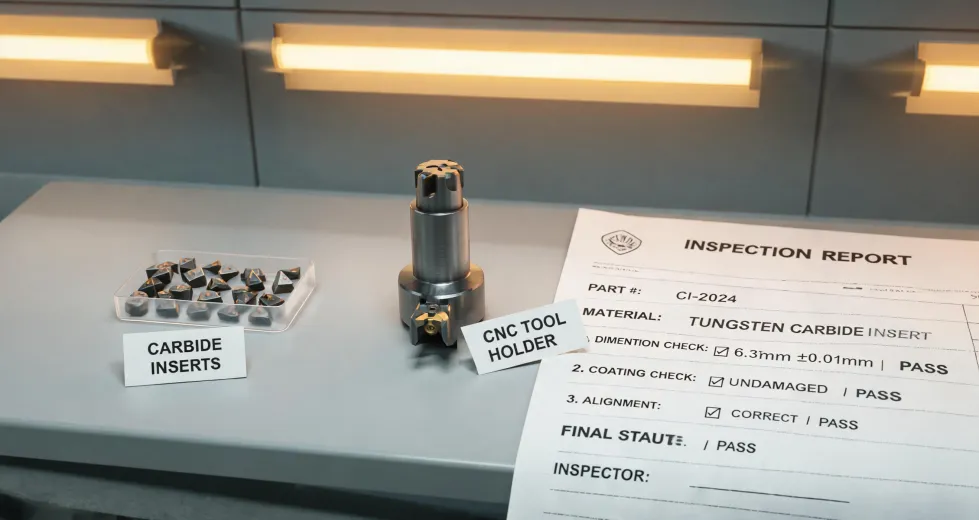
If you're ordering Kennametal carbide inserts without first checking the catalogue against your job's specifics, you're probably wasting money. I know because I've personally burned over $2,300 on wrong insert grades, incorrect chip breakers, and mismatched tool holders. The fix isn't complicated: respect the catalogue, and build a pre-order checklist.
I'm the guy who handles custom machining orders for a mid-size job shop. I've been at it for about ten years now, and I've documented 47 significant mistakes (that I know of) totaling roughly $23,000 in wasted budget. Yeah, it's embarrassing. But I've turned that into a checklist I maintain for our team, and it's saved us an estimated $8,000 in potential rework over the last 18 months.
The Mistake That Changed Everything
I didn't fully understand the value of the Kennametal catalogue until a $3,200 order came back completely wrong. In September 2022, we had a rush order for stainless steel parts. I picked a grade I'd used before for steel—good stuff, right? Wrong. The insert edge chipped on the third part. We scrapped 200 pieces before we caught it.
That error cost $890 in redo plus a 1-week delay. Missed deadline, angry client, and a lesson I won't forget: the catalogue has specific recommendations for a reason. It's not just a price list.
Why Your Gut Feeling is Wrong About Tool Selection
It's tempting to think a more expensive insert grade is always better. But that's a simplification that ignores the reality of modern machining. A super-hard PCD insert might sound great, but on a low-rigidity lathe with interrupted cuts? You're looking at premature failure. The Kennametal catalogue literally tells you this, but we skip it because we think we know better.
People think using the best tool on paper equals the best outcome. In reality, the best outcome comes from matching the tool to the specific operation, material, and machine condition. The assumption is that a higher number means better performance. Nope. Often, a specific geometry or coating designed for your exact application wins every time. The catalogue is the map; your machine is the terrain. Ignore the map, and you'll hit a ditch.
How to Actually Use the Kennametal Catalogue for Inserts
Here's what works, based on my mistakes:
- Start with the material. Don't look at grades first. Look at the material group you're cutting. Kennametal's catalogue organizes inserts by ISO material groups (P, M, K, N, S, H). I once ordered an M-grade for a steel job. Disaster.
- Check the chip breaker code. This is where I've made four separate mistakes. The same insert grade can have different chip breakers for roughing vs. finishing. The catalogue has a table. Use it. On a 500-piece order where every single item had a chip evacuation issue, we lost $450 worth of inserts and time.
- Verify holder compatibility. An insert that fits a tool holder physically might not be the correct one for the operation. The catalogue's cross-reference is your friend. I'll admit, my first year (2017), I ordered 50 inserts that fit the pocket but had the wrong clearance angle. $150 straight to the trash.
- Cross-check the application notes. The fine print in the catalogue includes notes on coolant, speed, and feed ranges. I ignored it once for a finishing pass on a 304 stainless part. Result: poor surface finish and a 2-hour rework.
The Hidden Cost of the Wrong Insert
It's not just the cost of the insert. It's the downtime. The scrap. The rework. The missed delivery. Missing the chip breaker requirement on a 300-piece order of Inconel resulted in a 3-day production delay and a $1,200 rush shipping charge. The catalogue had the right code listed clearly. I just didn't look.
Setup fees and rush charges in machining are brutal. Based on our shop's internal data (and a quick check on industry forums), a standard rush order premium is +50-100% over standard pricing. A simple check of the catalogue would have saved that.
When the Catalogue Isn't Enough (And When It Is)
Okay, here's the honest part. The Kennametal catalogue is fantastic for standard applications. But if you're doing something truly novel—like a new exotic alloy or a custom form tool—the catalogue gives you a starting point, not a final answer. You need application engineering support. I've called Kennametal's tech line three times in the last year. They actually helped solve a tough vibration issue on a deep boring operation.
But for 90% of the jobs we run, the catalogue has the answer. The problem isn't the catalogue; it's our decision to skip reading it. For high-volume production of common materials (like 4140 or aluminum), the stock grades and geometries are optimized. For short-run, high-mix jobs, the generic grades like KC5010 or KCU10 are safe bets, but always verify.
For laser tube cutting (like what we see in Delano or Tampa areas), the same principle applies: use the recommended cutting parameters and consumables. The equipment manufacturer's catalogue is your starting point. Ignoring it leads to bad cuts and wasted material.
And no, this doesn't apply to every CO2 laser treatment question—that's a whole different process with different boundaries. Stick to the data from the equipment manuals there.
So, here's my plea: before you place your next Kennametal order, spend ten minutes with the catalogue. Check the grade, the chip breaker, and the material group. It's the cheapest insurance you'll ever buy. Trust me, I've got the returned orders to prove it.